


Introduction to Bank Note Collecting
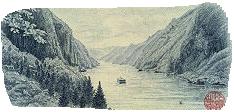
"People say when one collects something is a sign of a higher intelligence."
Collecting is a common human behavior influenced by a variety of psychological factors, including nostalgia, emotional attachment, curiosity, and the desire for order and structure. It can serve as a way to connect with the past, express personal identity, and find social belonging, while also providing a sense of accomplishment and intellectual stimulation.
Early human survival depended on gathering and storing resources, but modern research does not directly support a simple or universal link between collecting behavior, wealth accumulation, and life expectancy.
Collecting can also have positive emotional effects. It may reduce stress, improve mood, and create a sense of satisfaction. Surrounding yourself with objects you find meaningful or aesthetically pleasing can contribute to personal well-being. However, these effects vary significantly from person to person.
Despite what some collectors may say, almost anything can be collected. There is no need to wait for decades for an item to become “collectible.” Some people prefer newly manufactured items, while others focus on older or antique objects with historical value.
Most of us use banknotes every day without much thought. But how often do we look closely at the notes in our wallets, perhaps even using a magnifying glass or other tools? A closer examination of a banknote often reveals a rich level of detail, design, and historical information. This is one of the reasons many people become interested in banknote collecting.
There is no strict rule that limits what can or cannot be collected. Banknotes in any condition — whether crisp, circulated, damaged, or bundled — can all be part of a collection. Collecting and simply accumulating objects may be different processes, but both can be equally enjoyable depending on personal goals.
Collecting world paper money allows you to explore different countries and cultures without leaving home. Through banknotes, collectors may encounter geography, history, architecture, wildlife, and notable figures from around the world. In this way, banknote collecting can also encourage interest in subjects such as art, history, languages, and international affairs.
In a broader sense, building and maintaining a diverse world currency collection can give a symbolic feeling of participation in the global economy, while also reflecting the interconnected nature of modern societies.
The Unique Joy of Owning What No One Else Has
Collectors often express their passion in two different ways. Some proudly say, "I have what many of you have—plus more." Others prefer to say, "I have what most of you don't have, and I'm proud of it." While both attitudes reflect enthusiasm for collecting, they are driven by different motivations.
The first collector finds satisfaction in building a larger or more complete collection than others. The second is motivated by rarity and the excitement of owning something few—or perhaps no one else—possesses.
But this raises an interesting question: If you own a truly unique collectible that no other collector has, what are you actually enjoying that others have never experienced?
Part of the answer lies in the thrill of discovery. Finding an unknown variety, an unrecorded error, or a one-of-a-kind historical item is an experience that cannot be duplicated. There is also the satisfaction of preserving a piece of history and the intellectual challenge of researching its origin, significance, and story.
Yet collecting is rarely just about ownership. It is also about sharing knowledge, discussing discoveries, and inspiring others. A unique item gains even greater value when its story is documented and appreciated by fellow collectors. In that sense, the greatest reward is not simply being the only owner, but being the person who expands the knowledge of the hobby.
Ultimately, the true joy of collecting does not come solely from possessing something rare. It comes from the experience of discovery, the understanding of its history, and the opportunity to share that knowledge with future generations of collectors.
Collecting world banknotes connects people with global currencies, cultures, and economies.
|
Banknote and paper money collecting is an exciting hobby that is enjoyed by many thousands of people around the world. If you are new to this fascinating hobby of collecting banknotes from countries across the globe, I hope this website will provide you with beautifully presented images, as well as a wide range of interesting and useful information about thousands of banknotes from different countries and regions. It also aims to introduce how to start collecting, what to collect, and how to enjoy the hobby. People began systematically collecting paper money in relatively recent times. Although paper money collecting has existed for a long time, it was previously carried out on a very small scale. It was only in the late 1950s that banknote collecting began to develop into a more global hobby. By the 1920s, paper money had been issued by a significantly growing number of countries around the world, and by the early 1960s, paper currency was widely used for everyday transactions between individuals and businesses. As a result, more people began to collect banknotes both as historical objects and as collectible items, and in some cases as an investment. |
Today, world banknote collecting is growing steadily. There are millions of collectors worldwide, and new collectors join the hobby every year.
A wide range of general and specialised catalogues now exists, covering banknotes from both current and former countries. Prices for collectible banknotes vary, but many higher-quality notes have increased in value over time, making banknote collecting attractive both as a hobby and, for some, as a form of long-term interest-based investment.
Various countries around the world use different terms for “paper money”. Below are translations of the terms “banknotes” and “paper money” in several languages:
French: billets, papier-monnaie
German: Banknoten, Papiergeld
Italian: banconota, cartamoneta
Japanese: 紙幣 (shihei), お金 (okane)
Lithuanian: banknotai, popieriniai pinigai
Russian: банкноты, бумажные деньги
Spanish: billetes, papel moneda.
View a list of countries of the world, including modern states as well as former countries that no longer exist, and those that have since reunited or split into separate nations.
There are also uses for paper money, usually referred to as banknotes, beyond spending, collecting, or investing. One example is the creation of paper money art.
Banknotes are often collected rather than simply spent. Designing, issuing, and collecting world banknotes reflects and documents the world’s currencies, cultures, and histories.
Banknote collecting does not directly strengthen currencies or economies, but it does contribute to cultural preservation, education, and a greater appreciation of international heritage.
Culture, traditions, art, human activity, customs, history, education, folklore, architecture, and human knowledge all contribute to the character and identity of a place. Together, these elements form its atmosphere, sense of place, or “genius loci”.
The richer and more diverse these elements are, the stronger and more distinctive the character of a place becomes. Younger people, in particular, may find it easier to absorb new impressions, ideas, and cultural information from their surroundings.
Ways to Collect World Paper Money
"Most banknotes are collectible pieces of design and printing art, each bearing a unique serial number..."
| There are many ways to build a collection of world banknotes without needing to spend a large amount of money.
One approach is topical collecting. This involves collecting banknotes based on themes, such as those featuring famous individuals (scientists, writers, poets, politicians, educators, and others), animals, birds, fish, ships, vehicles, trains, planets, architecture, landscapes, rivers, mountains, and other natural or cultural subjects. Many such themes are represented on banknotes issued around the world. Another approach is historical collecting. For example, you may focus on pre-Second World War banknotes only, or specialise in World War II-era notes such as occupation issues, prisoner-of-war notes, propaganda notes, emergency issues, or local wartime currency. You may also choose geographic or national collecting strategies. For instance, you could collect banknotes from your own country, your country of birth, a specific continent, or a defined group of countries. Examples include the Middle East, NATO member states, or countries around the Pacific region. |
A good way to discover your collecting interests is to examine different types of banknotes, either through an online gallery, a dealer’s shop, or a paper money exhibition. You may find yourself particularly drawn to engraved notes, notes influenced by French design, notes with unusual serial numbers, holographic security features, or modern polymer banknotes.
It is also highly recommended to use reference literature, such as a catalogue of modern world banknotes, when starting your collection. Such resources can provide valuable information on identification, classification, and valuation. Please visit our online bookstore to view selection of books that may help you out in your hobby.
Finally, learning how to grade banknotes is an essential skill for collectors. Understanding grading is as important in this hobby as learning basic practical skills are in everyday life.
 |
A very simple way to start your world banknote collection is to buy a selection of inexpensive notes, for example at around $1 each, with one note from every different country in the world. Inspect the notes, study their features, and frame them if desired. When you have completed a basic collection of potentially 300 or more notes, you may, if your budget allows, wish to begin collecting notes of higher value, greater aesthetic appeal, and increased cost. For example, you may then choose to collect notes in the range of $1 to $10 each, and so on. Always try to buy two of each identical banknote, so that you can replace a damaged example if needed, frame one copy, or use the second one for trading with other collectors. Did you notice that two banknotes which appear similar may have different dates or signatures? There are also notes that look alike but were printed by different printers. In addition, almost every banknote has a unique serial number. Here are a few more ideas for starting or developing your world paper money collection. You may wish to begin or expand your collecting focus by: |
-
Topic (birds, nudes, sailing ships, famous people, landscapes, militaria, etc.)
-
Time period (Second World War, 20th century, notes dated 1999, etc.)
-
Country (your native or favourite country)
-
City (city that issued the note; applicable to local issues)
-
Continent (Africa, Europe, Antarctica, etc.)
-
Features on a note (holograms, security threads, paper type)
-
Material used (paper, polymer, mylar, cloth, etc.)
-
Signatures (many varieties exist)
-
Serial numbers (e.g. 111111, 000001, 123321, specimens 000000, etc.)
-
Name of printer (company or government authority that printed the note)
-
Influence zone (for example, France and former colonies)
-
Size (e.g. collect only large-size notes or notes within a certain size range)
-
Condition/grade (e.g. collect only uncirculated notes or only circulated notes)
-
Science (e.g. notes featuring biology, astronomy, engineering, etc.)
-
Watermark (type of watermark or embedded image)
-
Type (counterfeit/bogus/forgery notes; specimen notes; error or trial notes, etc.)
Some banknotes become very popular and even scarce or rare shortly after they are issued. People may even be willing to stand in queues overnight to obtain certain banknotes. In some cases, older or obsolete banknotes are destroyed by issuing authorities to remove them from circulation, which can contribute to the scarcity of surviving examples.
Please remember: the stricter your collecting criteria, the fewer banknotes you are likely to include in your collection, or the higher the overall cost of building it. However, the more focused your collection becomes, the greater its potential specialist value.
If you are just starting out in paper money collecting, it is generally better not to focus on investment. Instead, collect the notes you like and enjoy the process. As you become a more experienced collector, you may learn how to acquire notes that have both aesthetic and potential investment value.
After all, collecting banknotes may bring you happiness and good fortune.
Back to Top
World Currency Names: Why is a Franc called a Franc?
|
Have you ever wondered why different kinds of money are called what they are? Why is the peso called a peso, or the mark called a mark, for example? The following list explains the origins and meanings of some world currency names. ARIARY (Madagascar) – a name for a silver dollar. AUKSINAS (Lithuania) – means “golden” or “gulden”. Auksinas derives from the Lithuanian word auksas, meaning “gold”. COLON (Costa Rica, El Salvador) – derives from the surname of Christopher Columbus (Cristóbal Colón). DRACHMA (Greece) – means “handful”. |
ESCUDO (Portugal) – means “shield”, referring to the coat of arms on the original coin.
FORINT (Hungary) – comes from the city of Florence, where gold coins called fiorino d’oro were minted from 1252. In Hungary, florentinus (later forint), also a gold-based currency, was used from 1325 under Charles Robert.
FRANC (France, Switzerland, Luxembourg) – first issued in 1360 as a gold coin. The name comes from the Latin inscription Francorum Rex, meaning “King of the Franks”, a title used by the kings of France in the 14th century.
GUILDER (Gulden, Florin) (Netherlands) – from the same root as “gilded”. The guilder was originally a gold coin introduced from Florence in the 13th century. Florin, another name for the guilder, means “flower”.
KORUNA (Czechia, Slovakia) – means “crown”.
KRONA (Kroner, Kronor) (Iceland, Sweden, Norway, etc.) – means “crown”.
KUNA (Croatia) – means “marten”. Historically, marten pelts were used as a form of currency.
KWANZA (Angola) – derives from the Kwanza River, the largest river in Angola.
LIRA (Italy, Turkey) – from the Latin word libra, meaning “pound”.
MALOTI (Kingdom of Lesotho) – Maloti is the plural of Loti, the currency of Lesotho, a kingdom in Southern Africa.
PESETA (Spain) – means “little peso” and was created in the 18th century as a companion coin to the Spanish peso.
PESO (Mexico) – means “weight”. It was introduced by Spain in 1497 and later adopted by Mexico and other Latin American countries in the late 19th century.
POUND (England) – named for its weight in sterlings, the currency unit of medieval England. The first pound coin was issued in 1642.
PULA (Botswana) – means “rain” in Setswana. However, “pula pula” does not mean “a lot of rain”; it means luck, prosperity, and health.
RIYAL (Saudi Arabia) – derives from the Spanish real, meaning “royal”.
ROUBLE (Russia, Belarus, etc.) – means “cut-off”, a term from the period when portions of silver bars were cut into pieces and used as currency. The rouble was first issued as a silver coin in 1704.
RUPEE / RUPIAH (India, Indonesia, Sri Lanka, Mauritius, etc.) – comes from the Sanskrit rupa, meaning “beauty” or “shape”. Another explanation links it to rupyakam, where raupya means “silver” and rupyakam means “coin made of silver”.
TAKA (Bangladesh) – derived from the Sanskrit tanka, an ancient silver coin denomination. The name was also historically used in North India.
TENGE (Kazakhstan) – means “a set of scales”.
YEN (Japan) – borrowed from the Chinese yuan, meaning “round”, describing the shape of the coin. First issued in 1870.
YUAN (China) – means “round” and describes the shape of the coin.
ZLOTY (Poland) – means “golden”.
Current and Historical World Currency Names and Their Countries of Origin
Back to Top
How to Invest and Promote Using Banknotes
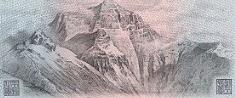 |
We believe that investing in a well-curated collection of world banknotes (including collectible paper and polymer currency, as well as obsolete and historical banknotes) can be more rewarding in the long term than investing in other commodities such as gold, stocks, or even immovable property. Have you ever considered buying an extra house or a parcel of land purely for investment purposes? Stop and think. What about property taxes? Home insurance? Potential damage caused by tenants? And can you take your property with you when you move? |
By investing in a collection of world banknotes, you may avoid many of these costs and practical challenges.
Invest in world banknotes. Investment in collectible currency (banknotes) and banknote collecting has been active for decades and continues to grow in popularity.
Why is investing in banknotes attractive? Because banknotes (paper and polymer money, both current and historical) often carry collectible value, which in many cases may increase over time.
Investment in banknotes can be considered an alternative to traditional assets such as stocks, gold, or real estate, depending on personal preference and market conditions.
Thoughts for 2026–2035: USD, GBP, and EUR are relatively stable, yet inflation remains significant in many economies. One way some collectors aim to preserve value is through carefully selected banknote collections.
International travel has become more expensive, and the purchasing power of savings may have changed compared to previous years. However, this depends on many economic factors, and outcomes vary.
A carefully selected collection of banknotes may, in some cases, help preserve value or provide long-term collectible appreciation, although this is not guaranteed.
A typical suggested range for a middle-income collector might be approximately $5,000 to $25,000 USD, CHF, GBP or EUR (or equivalent in another major currency) per year, or more. Lower amounts are generally considered collecting rather than structured investment.
N.B.: Never underestimate your country’s economy’s ability to recover and adapt after a crisis.

Let’s talk about inflation.
Inflation is a general increase in the prices of goods and services over time, usually expressed as an annual percentage rate. For example, if the inflation rate is 5%, it means that prices increase by approximately 5% per year.
As an example, a basket of goods and services that costs $1,000 today would cost around $1,050 next year at a 5% inflation rate.
Inflation reduces purchasing power over longer periods. For example, if you have $100,000 today and leave it in a bank account while inflation averages 4% per year, its purchasing power would be approximately $82,193 after five years. After 10 years, it would be approximately $67,556. This represents a loss of purchasing power of over $32,000 over 10 years.
Inflation reduces the real value of savings over time. One way some collectors choose to respond to this is by building a carefully selected world banknote collection. A stronger and more specialised collection may, over time, retain or increase its collectible value depending on demand and rarity.
How much should you invest? There is no fixed minimum or maximum amount. The more you invest in your collection, the more developed it may become over time. A long-term approach of 15 years or more (possibly 20–30 years) is often considered by collectors.
If you start with $500, you may continue expanding your collection gradually over time. Many collectors choose to acquire between one (1) and ten (10) examples of the same banknote to allow for trading, resale, or replacement purposes.
It is also important to protect your collection properly. Collectors often use protective holders, albums, safes, and in some cases fire-resistant storage solutions. Proper storage helps preserve condition and long-term collectability.
At the same time, collecting should not be seen only as investment. It should also be enjoyed for its visual appeal, educational value, and cultural significance.
Many emerging economies, including China, India, and parts of Central and Eastern Europe, are growing rapidly. The number of banknote collectors in these regions is also increasing significantly. At the same time, supplies of older banknotes are becoming more limited, which can increase interest and demand in certain segments of the market.
Some banknotes can become rare quite suddenly. At a certain point in time, demand for a specific note may increase sharply while supply remains limited, resulting in rapid scarcity in the market. In such cases, dealers and collectors may find that a particular note becomes difficult to obtain within a short period of time.
This can occur with virtually any banknote in a collection. Careful research and observation of market trends may help collectors identify which notes could become more difficult to find, or potentially more sought after, in the future.
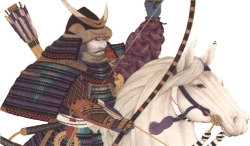 |
Why Banknotes Are a Popular Collectible Investment TodayLet’s compare real estate (immovable property) with banknotes and collectible currency. Real estate investment generally requires a substantial amount of capital. It is not accessible to everyone, especially for beginners or small-scale investors. In contrast, banknote collecting and investment can be started at a much lower entry level. Both real estate and banknote collecting can be considered tangible forms of investment. In both cases, you can see, touch, and appreciate the physical asset, including its design, appearance, and aesthetic qualities. However, to invest in real estate, one typically needs hundreds of thousands or even millions of euros, dollars, yen, or reals. By comparison, banknote collecting can begin with a much smaller amount. You can start a basic collection with as little as $30 or less, for example by purchasing a beginner set of world banknotes. |
Gold vs. Banknotes
When comparing gold and banknotes, most people agree that gold is beautiful, and banknotes are also beautiful in their own way.
Gold is generally considered extremely durable and resistant to damage, whereas banknotes can be burned or physically damaged and therefore require proper protection and careful storage.
Gold is often seen as faceless and abstract, unless it is part of an artistic gold collection. Banknotes, on the other hand, have “faces”. In fact, they have many faces, and not only faces. Banknotes represent art, education, and history all at once. Finally, banknotes are also money, and some of them can still be used for payment without any need for appraisal.
There is a common belief that much of the world’s gold is no longer physically accessible in the same way as in the past, including in major financial institutions. This leads some people to consider diversifying their interests into collectible banknotes and currency notes.
Do not wait too long. Collect as wide a variety of banknotes as you can reasonably afford.
How to Lose Weight by Collecting World Banknotes
Rule #1: Replace sodium, trans fats, saturated fats, and partially hydrogenated oils in your diet with vegetables, minerals, and supplements. Replace sugary drinks with spring water. Drink water regularly and maintain a balanced diet. You will lose weight if you exercise enough and consume fewer calories. It is widely accepted that reducing calorie intake can contribute to improved health and potentially longer life expectancy.
Once you lose weight, you may feel better and have more energy. Over time, this may give you more time and resources for your hobbies. Collect banknotes.
Pursuing a collection of world banknotes, drinking enough water, eating properly, spending time outdoors, and exercising may contribute to lower stress levels, improved wellbeing, and a healthier lifestyle.
Time is Money, but Money is Timeless
Time is money… money is timeless.
Take a look at a banknote in your hand or in your collection album. Does it have a “gender”? Is it a he, she, or it? This is for the collector to decide.
Most banknotes include a printed date. This date usually indicates when the banknote was approved, printed, or issued for circulation in a particular country.
To a collector, this date can represent a specific moment in time, sometimes even marking a broader historical era. In some cases, it may also connect personally to an important life event, such as a birthday or memorable date. Collecting banknotes with meaningful dates can become an interesting challenge.
Final Questions
What is the best way to preserve wealth?
Are banknotes for you works of art and collectible items, or simply things to be spent?
 |
What Would a Collapse in the Value of the Dollar Mean for the United States?A collapse in the value of the US dollar would have significant economic consequences for the United States. In general, it would likely be considered negative for the economy and could reflect broader financial instability or declining confidence in the currency. However, some alternative assets and collectible markets—such as banknotes, gold, and silver—are often viewed by some investors as potential hedges in periods of currency weakness or inflationary pressure. |
That said, the most important investment remains your own health and the wellbeing of your loved ones. Taking care of yourself should always come first, and your world banknote collection will be there for you to enjoy over time.
Collecting a wide range of items, including banknotes, can be an enjoyable and engaging hobby. Many collectors find that hobbies help them relax and focus, which may contribute to a sense of wellbeing and reduced stress levels.
Maintaining a balanced lifestyle, including moderation in diet, regular activity, and time for personal interests, is generally associated with better overall health and wellbeing.
Eat in moderation – Collect world banknotes.
Note: The above text represents a personal opinion and should not be interpreted as financial advice.
Are You Buying Gold? Think Again – Consider Banknotes as Well
Would you consider taking a risk and buying gold again? Think twice. Read the extract below and consider collecting or investing in banknotes instead.
Some people believe that gold is money, but others argue that this is no longer the case.
“For hundreds of years, much of the world operated under gold-based monetary systems. Gold was used as currency and to settle debts between nations. Paper currencies originally emerged as warehouse certificates representing gold and, in some cases, silver.
However, this system changed significantly in 1933, when President Roosevelt ordered U.S. citizens to surrender their gold and silver to the government under penalty of fines and imprisonment. In effect, the U.S. government centralised gold holdings, and for several decades private ownership of gold was restricted, with some exceptions such as rare coins.
For the following years, private ownership of gold in the United States remained restricted until later policy changes in the 1970s.”
Source: http://www.isil.org
Human activity creates the soul of a place. Financial activity creates an economy.
 |
Gold is often described as a strong investment today, although some argue that in recent years its price has risen significantly, meaning entry levels may feel higher than before. Gold is widely regarded as valuable, but some people consider it less visually engaging or varied compared to collectible items. Would you rather look at a piece of gold or a piece of art? Gold can be extracted from mines and refined, whereas a banknote is issued and printed in a limited quantity, usually by a governmental authority. It cannot simply be reproduced or “dug up” again once production has ended. Banknotes are not found on other planets either. Banknotes are often harder to preserve in good condition than gold, which means that scarcity can increase more quickly in certain cases. Banknotes are also closely linked to consumer spending and economic activity, which some consider more directly connected to everyday life than gold. In many cases, governments withdraw, shred, or destroy certain issues of banknotes, which can contribute to their scarcity or rarity over time. |
Banknotes are light and easy to handle, whereas gold is heavy, although it can be melted and transformed into jewellery, coins, and other forms.
Most banknotes carry serial numbers, which makes each piece individually identifiable and adds to their appeal both as collectibles and as investment objects.
Scarcity, visual design, and educational value are key reasons why some collectors prefer banknotes over gold.
What appeals more to you?
Many collectors choose to diversify into both banknotes and gold, as both remain more accessible than immovable property for most people today.
Disclaimer
This website is made available on the understanding that it has been prepared for informational purposes only. The Provider or Author is not engaged in rendering legal, accounting, financial, or other professional services.
The information on this website is not intended to create, and use of or access to this website does not constitute, a lawyer-client relationship, accountant-client relationship, or any other professional relationship of any kind.
If legal, financial, or other expert advice is required, the services of a qualified professional should be sought.
The Provider or Author disclaims all warranties, and accepts no responsibility for any loss, damage, or risk incurred as a result of the use or reliance, whether direct or indirect, of any information presented on this website.
Back to Top
 |
The Chinese were the first to invent paper around 100 AD. They were also the first to invent paper money, which in its early form can be traced back to the 7th century. |
These first bank notes carried a guarantee that it could be traded at any time for coinage. The name of this bank note was "cash".
The oldest existing bank note is the 1000 cash note of the Ming dynasty from the era of the Great War 1368-1398. It is 225 x 340 mm with a pile of coins centrally depicted . The picture was to show people who couldn't read that they could trade the bill in for the depicted number of coins.
When Marco Polo came back from his travels in China (1275-1292), people in Europe didn't believe that the Chinese used paper for money. Paper money in Europe came 300 years later. The use of paper money in China stopped in 1455.
The history of paper money in Europe is interesting. It started as emergency money sustituting for regular money. The first emergency paper bills are from 1483. The first bank notes were printed in the 17th century.
The first European banknotes were printed in Sweden.
In 1644 copper plate money was minted, but besides being very heavy it was quickly devalued because of the 30 Years War (1618-1648).
Therefore, Johan Palmstruch, who in 1657 founded the Stockholms Banco, suggested as a new monetary unit - a temporary "Kreditivsedlar" (credit paper). He printed the first banknotes in 1661.
Unfortunately for Johan Palmstruch, all this came to a bitter end. The bank very quickly got into trouble for printing too many bank notes. Palmstruch was taken to court and was made accountable for damages and was sentenced to prison. Not many Stockholms Banco-Notes remain today and are a rare collectors item.
A battle had raged for decades between the King and the merchants, for control over England's money system. The arrival of William III of Orange in 1688 with his "glorious revolution" heavily financed by merchants tipped the scales in favour for the often spoken wish for an independant credit institute.
Following the suggestion by William Patterson, the Bank of England was founded in 1694. The Bank of England printed "Goldsmithnotes" as promissory notes from English goldsmiths for account deposits. The clause "(I) promise to pay the bearer on demand the sum of (...) pounds" (i.e. in gold) originally meant that they could be exchanged for gold, although in practice this was not always possible.
The state received a loan in exchange for the right to print banknotes. In time the Bank of England developed into the most influential bank of issue bank in the world.
One year after the founding of the Bank of England, the Bank of Scotland was initiated. It held the bank note monopoly for Scotland until 1717. Also in Norway, which at the time was a Danish province, in1695 the businessman Thør Møhlen, circulated banknotes (without interest) with the approval of the government. The notes had 5 wax seals. Unfortunately the population didn't find them acceptable and brought them immediately to the bank to cash them in. As a result, Thør Møhlen came into financial difficulty.
It wasn't until 1713 that Denmark began circulating paper money during the war with Northern Ireland. It was also served as a form of emergency coinage and emergency money.
France also began printing paper money in the year 1703 under Louis XIV. Because of uncertainties connected with paper money, other states waited until the late 19th century.
One problem with paper money was the paper itself. Several companies experimented with the processing of special paper in the 18th and 19th century.
Information (History of P. M.) from http://www.moneymuseum.com
Back to Top
Recognising Original Banknotes
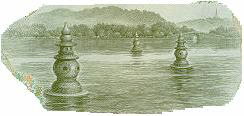 |
Recognising Original Banknotes One of the first steps to proper grading is to recognise the features of an original banknote. This will allow you to draw certain conclusions regarding the condition. In order to recognize the features of an original banknote it is necessary to have a general understanding of the printing processes and the features used in producing banknotes. There are many different types of printing processes and books have been written on these topics but for the layperson who is simply interested in acquiring general knowledge, we have drawn some generalizations to help in this understanding. |
Printing Process
The earliest printing process, the woodcut, is produced by cutting away the unwanted part of a piece of wood. The design that is left in relief is inked up with a roller and transferred to paper. The design is drawn directly on the wood which is cut plankwise or along the length of the grain or tree trunk. Cut this way, however, the wood has a tendency to splinter. Artists discovered that they could avoid the problem by cutting on the end grain of hardwood blocks, a process called wood engraving. By using a burin, the wood engraver could produce a wider range of tones than were possible with a woodcut. This process was used on a few types of early style currency and in certain "emergency" cases where this was the only type of printing process available.
Lithography
Lithography was the first fundamentally new printing technology since the invention of relief printing in the fifteenth century. It is a mechanical planographic process in which the printing and non-printing areas of the plate are all at the same level, as opposed to intaglio and relief processes in which the design is cut into the printing block. Lithography is based on the chemical repellence of oil and water. Designs are done with greasy ink or wax based tools on specially prepared stones or plates. They are then is moistened with a liquid, which the plate accepts in areas not covered by the wax. An oily ink, applied with a roller, adheres only to the drawing and is repelled by the wet parts of the plate. The print is then made by pressing paper against the inked drawing. Lithography was invented by Alois Senefelder in Germany in 1798 and, within twenty years, appeared in England and the United States. Almost immediately, attempts were made to print in colour. Multiple plates were used, one for each colour, and the print went through the press as many times as there were plates. The problem for the printers was keeping the image in register, making sure that the print would be lined up exactly each time it went through the press so that each color would be in the correct position and the overlaying colors would merge correctly.
Intaglio/Engraving
The process of intaglio printing was and still is the most popular form used by banknote printing companies. It is an extremely time intensive process and requires the combined handiwork of highly skilled artists, steel engravers, and plate printers. Engraved printing plates are covered with ink and then the surface of each plate is wiped clean which allows the ink to remain in the "valleys" of the design and letter grooves of the plates. Each sheet is then forced, under extremely heavy pressure, into the finely recessed lines of the printing plate to pick up the ink. The printing impression is three-dimensional in effect creating "mountains of ink" on the banknotes. The height of these "mountains" depends upon the depth of the grooves that the engravers made on the plates, the quantity and type of ink used, and the pressure applied to force the paper into the plates. The surface of the note feels slightly raised, while the reverse side feels slightly indented. This process is called intaglio printing.
Definition of Original Raised Ink
An original banknote printed using the Intaglio process noted above will have definition of detail discernable by touch. There will be height to the ink. Different parts of the banknote will feel more raised up than others due to the fact that the engravers would engrave the plates at differing depths for different features of the banknote. As time goes by and the banknote gets circulated more and more, the height of the ink is slowly worn down until the note finally ends up looking "flat" and loses it's bright colours. If a banknote is washed or pressed, the "mountains" become flattened and loss of definition is noticeable. A true original high grade banknote will retain some or all of this original definition.
Counterfeiting
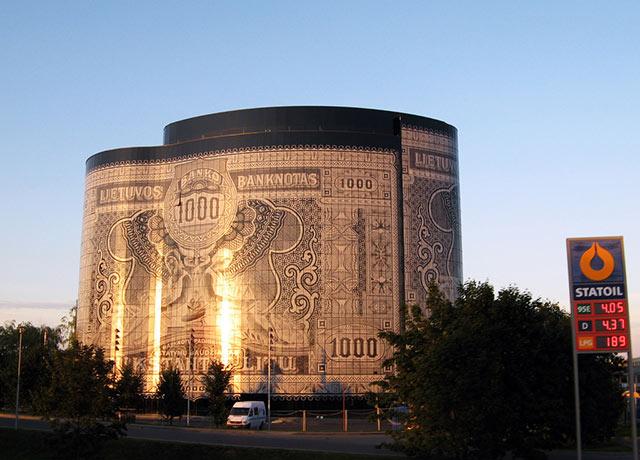 Banknote Building in Kaunas, Lithuania |
Counterfeiting banknotes pervades the entire history of paper money. Tools to aid in the battle against counterfeiting were and remain the finesse and complexity of design and printing techniques. Coupled with special papers and security features, banknote printing companies and issuing authorities ensure that their paper money would be very difficult to reproduce. The avid collector will encounter forged notes from time to time that even the untrained eye can detect. There are however examples in history whereby a sovereign nation or country has produced so-called "perfect" counterfeits of an enemy country. These were normally created and secretly sent into circulation in order to create inflation with the ultimate goal being to bring about the economic instability of the adversary. To the collector, identifying these counterfeits requires great experience. With modern computers and printers, it has become easier for unscrupulous individuals to reproduce certain lithographed banknotes that were originally issued without many security features. As an example, the uni-face 1940 KGVI fractional issues from Mauritius lack virtually any security features and even the original printing was quite poor in quality. |
Original banknotes in Uncirculated condition fetch considerable sums. The combination of the above factors has resulted in the modern forgery of these banknotes. To all but the expert eye, they are virtually undetectable.
Security Features
Numerous security features have been used throughout the course of history. Modern security features are extremely elaborate and utilize certain older techniques coupled with techniques developed through fantastic technological advances.
Paper Quality
The quality of banknote paper is one of the characteristic features that distinguish a genuine banknote from a forgery.
Engraving techniques
The process of engraving requires expertise and long hours to produce designs deterring all but the very devoted forger.
Watermarked paper
Watermarking is the addition of a design or portrait put onto the paper using a special technique. The image is visible only when the paper is held against the light.
 |
Numbering Serial numbers are printed horizontally and vertically with assymetrical fonts and different colours to make them more difficult to counterfeit. They are also printed with special inks which penetrates the paper. As a result, the trace of the numbers can still be seen under ultra-violet light if the numbers were to be tampered with. Latent Image This security feature is based on the optical effect produced by light when introduced to special arrangement of plastic lines printed by intaglio technique. The picture becomes visible only when the note is held at the eye level in a horizontal position against a source of light. Microtext Part of the background of banknotes contains micro-lettering which can be viewed under a magnifying glass. |
Signatures and Dates
Combinations of different signatures and dates creates other variables adding to security.
See-through Features
Visible from both sides of the note, they are readily identifiable see through window features even under low light conditions. This security feature is currently only being used on Polymer notes.
Security Strip
A security thread is clearly visible when the banknote is held against the light. The thread is incorporated into the paper across the full width of the banknote and sometimes contains the microtext. A security thread may be metallic.
OVD - Optically Varying Device
Clearly visible optical shifts are generated when the note is tilted to the light.
Use of Polymer (plastic) for Banknotes
Becoming more popular due to the difficulty of forging as well as the superb strength and lifespan of the polymer notes.
Synthetic Fibers (threads) in the Paper
Usually visible colour threads added to the paper. More recently, fluorescent fibres in red, blue and green embedded in the banknote paper, only visible under ultraviolet light.
Shadow Image
A contrasted image appears when the banknote is held up to the light.
Invisible Fluorescent Printing
Invisible under normal conditions, elements of the design will fluoresce when seen under ultra-violet light.
Anti-Scanner/Copier Patterns
A coloured foil design is hot-stamped onto the paper and is over-printed in using a lithographic technique. When photocopying is used to reproduce the note, a black spot appears in place of the foil.
Back to Top
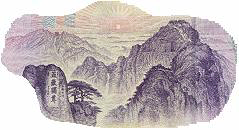 |
Handling Banknotes Most banknotes you will handle will be made of some sort of paper. Although a number of countries nowadays are adopting a polymer substrate (type of plastic), the vast majority of banknotes available to the collector will be made of paper in one form or another. |
Once you are finished handling the banknote, place it back into its holder. This should be done with the utmost care as this is when most banknotes become torn or creased. If you are viewing a dealer's banknote and are having any type of trouble getting it back into the holder, it is always better to hand the banknote and the holder back to the dealer and allow them to complete the task.
By virtue of its nature, a piece of paper money has a limited life expectancy, which is directly proportional to the amount of handling it receives.
From Printer to Bank to Wallet or Your Collection
The handling of a banknote used to begin at the printers with a manual counting of the sheets both prior to printing and then again prior to cutting. This is now done mechanically with little to no evidence of handling.
 |
In the very early years of banknotes, the actual cutting was done by hand which is noticeable by varying margin sizes of many countries banknotes. After cutting, the banknotes were recounted, stacked and bundled. Bundling was accomplished by a variety of different methods and often created marks on the edges of the banknotes in the bundles (or bricks) as well as the banknotes on the top and bottom of the stacks. The bundles are then stacked and either stored or shipped to the appropriate issuing authority. Storage was not always done in climate-controlled environments and in certain countries the effects of the natural environment are noticeable on the banknotes. This is particularly noticeable in banknotes from countries with a tropical climate. While in storage vaults, banknotes were often counted regularly for auditing purposes. They were normally kept in their respective bundles and often only random bundles were counted, however in the case of certain issuing authorities all bundles were regularly counted which created "counting creases" on these banknotes. If a banknote made it this far without traces of handling, these counting creases were often the first visible signs of handling manifested. |
Upon requisition by a bank or bank teller, the banknotes would be further counted, usually more than once, before being released to the general public. Certain countries issued banknotes that were quite large which necessitated folding by the tellers in order to fit them into their boxes or drawers. Even if a teller did not need to fold the notes, it was certainly a necessity for a customer to fold the banknote to fit it into their wallet or purse. Banknotes from these countries are extremely difficult to find without varying degrees of folds in even the cleanest, crispest banknotes put away during that time.
Modern equipment and machinery has created a process whereby a banknote may now remain virtually untouched and pristine until the moment a bank teller hands the banknote to a customer.
The above steps relay the difficulties that collectors of old notes / times had in obtaining truly UNC notes. Many other factors, unrelated to grade, created additional obstacles for the early paper money enthusiast including economic factors, the relative unpopularity of collecting paper money in those days, the stigma attached to paper money in relation to precious metals with intrinsic value, not to mention the fact that paper money was almost always worth more than coins and very few individuals could actually afford to "save" a piece of paper money.
When we die, our bodies turn into soil, which feeds trees and plants, such as cotton, and when paper is made from those plants, some of that paper goes to produce paper money (bank notes; notes issued by banks), the banknotes that you and I collect. Therefore please respect each other and let's respect the banknotes we collect and take a good care of them.
Back to Top | Ready to Collect? | The IBNS Introduction to Banknote Collecting


